From the Duke to the Adaptive: How Xbox Controllers Changed the Way We Play
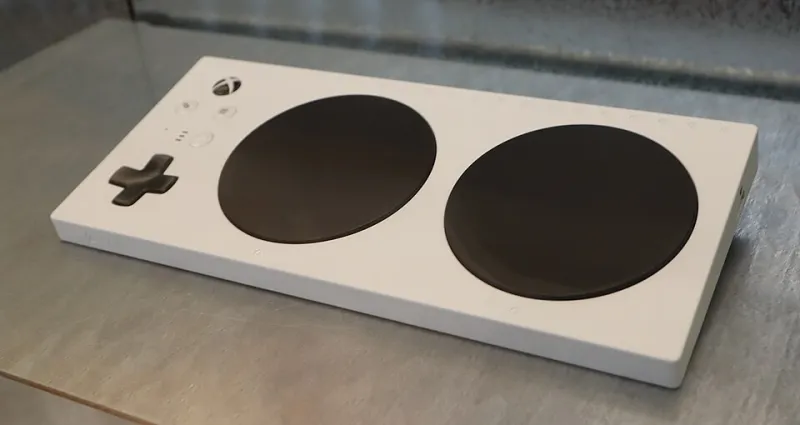
Photo: Geni, CC BY-SA 4.0, via Wikimedia Commons
Pick up an Xbox Series X controller today and it just feels right. The weight, the grip, the placement of the thumbsticks — it all clicks into place like it was designed specifically for your hands. But that comfort didn't happen by accident, and it certainly didn't happen overnight. It took Microsoft about twenty years of listening, iterating, and occasionally getting roasted by the gaming community to land where it is today.
The story of Xbox's controller evolution is really the story of Xbox itself: a platform that started a little rough around the edges but kept pushing until it earned its place in the living rooms of millions of American gamers.
The Duke: Bold, Bulky, and Unapologetically American
Let's be honest — the original Xbox controller, affectionately (and sometimes not so affectionately) known as the Duke, was a unit. Released alongside the original Xbox in 2001, the thing was enormous. It had six face buttons, a pair of analog triggers, and a footprint that made it feel less like a gaming peripheral and more like something you'd find in an aircraft cockpit.
For players coming from PlayStation or Nintendo, it was a genuine culture shock. Critics called it unwieldy. Import gamers who had already been playing with the smaller Japanese version — the "Controller S" — were baffled by its size. And yet, there was something undeniably ambitious about it. Microsoft wasn't trying to copy what came before. They were swinging big, even if the swing missed for a lot of people.
The Duke did have its defenders, particularly among players with larger hands who found it more comfortable than the competition. But the writing was on the wall pretty quickly, and by 2002, Microsoft had released the Controller S in North America — a slimmer, more ergonomic redesign that became the de facto standard for the rest of the original Xbox's lifespan.
Lesson learned: community feedback matters, and Microsoft was paying attention.
The 360 Era: Getting It Right
If the original Xbox controller was a rough draft, the Xbox 360 controller was the finished thesis. Released in 2005, it nailed the fundamentals in a way that the industry is still chasing. The offset thumbstick layout, the convex face buttons, the textured grips — it all came together into something that felt genuinely intuitive.
The 360 controller became a gold standard not just for console gaming but for PC gaming too. Developers started treating it as the default reference point for control schemes. It became so embedded in gaming culture that even today, PC games often display Xbox button prompts by default, regardless of what controller you're actually using.
What made the 360 pad special wasn't any single feature — it was the sum of the parts. Microsoft had clearly done the ergonomic homework, and it showed. The controller aged so well that its basic layout survived largely intact through the Xbox One generation and into the current era.
The Xbox One Tweaks and the Rise of the Elite
The Xbox One controller (2013) didn't reinvent the wheel, but it made smart refinements. Rumble motors in the triggers — called impulse triggers — added a layer of tactile feedback that felt genuinely next-gen. The bumpers got a redesign (though that one was more controversial), and the overall build quality ticked up a notch.
But the real statement piece of this era was the Xbox Elite Controller, which launched in 2015. At $150, it was a premium product aimed squarely at serious players. Swappable components, hair-trigger locks, adjustable tension thumbsticks, and a set of removable paddles on the back — it was the first time a major console manufacturer had delivered a truly pro-level controller at retail.
The Elite wasn't for everyone, and the price point made sure of that. But it sent a clear message: Xbox was committed to giving players options, not just a one-size-fits-all approach. The follow-up Elite Series 2 in 2019 pushed that even further with rechargeable batteries, shorter hair trigger locks, and even more customization depth.
The Adaptive Controller: A Genuine Game-Changer
Everything Microsoft had learned about listening to its community came together in 2018 with the Xbox Adaptive Controller. And honestly, calling it just a "controller" undersells what it actually represents.
Designed in collaboration with organizations like The AbleGamers Charity, The Cerebral Palsy Foundation, and SpecialEffect, the Adaptive Controller is built around the idea that gaming should be accessible to everyone — including players with limited mobility. The large programmable buttons, the array of 3.5mm jacks for connecting external switches and assistive devices, and the flat, easy-to-use design weren't engineering compromises. They were deliberate, thoughtful choices made with a specific community in mind.
The gaming world noticed. The Adaptive Controller picked up awards, earned widespread media coverage, and — more importantly — actually got into the hands of players who had struggled to find accessible options. It was a rare moment where a major corporation's product launch genuinely moved people.
For Reloaded XB, this is where the controller story gets really interesting from a cultural standpoint. Xbox didn't have to make this product. It wasn't a guaranteed sales win. But it reflected a philosophy — that the controller is a gateway, and that gateway should be open to as many people as possible.
The Series X Controller and Where We Go From Here
The current Xbox Wireless Controller, which shipped with the Series X and Series S in 2020, is a refinement rather than a revolution. A textured grip, a dedicated Share button, USB-C charging, and a slightly tweaked bumper design round out the changes. It's not flashy, but it's an acknowledgment that sometimes the best move is to not mess with what's working.
What's interesting is where Microsoft seems to be headed. The company has been pushing harder on cloud gaming and cross-platform play, which means the controller needs to work seamlessly across more devices than ever — consoles, PCs, phones, tablets, smart TVs. That's a different design challenge than just making something comfortable for couch gaming.
Rumors and patent filings have hinted at future controllers with built-in haptic feedback upgrades, modular components, and even deeper accessibility features. Whether any of that materializes remains to be seen, but the trajectory is clear.
Why Any of This Matters
It's easy to dismiss controller design as a niche concern — hardware trivia for the kind of people who argue about D-pad angles on gaming forums at 2 a.m. (not that there's anything wrong with that). But the controller is literally the point of contact between a player and a game. It's the thing in your hands for hundreds, sometimes thousands of hours.
The way Xbox has approached that interface — with a willingness to scrap what isn't working, invest in premium options, and extend access to players who've historically been left out — is a window into the platform's values. It's not just product development. It's a philosophy.
And for anyone who grew up gaming on Xbox, holding that current controller and thinking back to the Duke? That's a pretty remarkable twenty-year arc.